You may not realize it, but there is an invisible world all around you. This includes the air that I breathe and the microscopic particles floating in it.
Unfortunately, some of these particles pose a health risk to my bodies. One way to protect your family from these harmful contaminants is by using an air purifier in your home.
But where to start?
We’ll show you why an air purifier should be considered a necessity for every home.
Important Reasons to Have an Air Purifier
There are several important reasons why an easy-to-use air purifier is a necessity in your home. Here are some reasons why you should have one:
They help control allergies and congestion by filtering out anything floating in the air around you, such as dust mites, pollen spores, mold spores, and other allergens.
They work well to eliminate odors that come from pets or smoking inside your home or car.
They can help keep the air in your home clean and smelling fresh by getting rid of any unwanted smells.
They work well to reduce other health risks that come from breathing contaminated air, such as flu viruses, dust mites, or carbon monoxide gas leaks.
If you have a family member with asthma or allergies, this is especially important for them.
Air purifiers are definitely something to consider having in your home if someone suffers from either of these conditions because they could make a big difference when it comes to their overall quality of life.
The best place to use an air purifier would be in small areas where there is not much room like bedrooms and offices, since smaller spaces often get dirtier faster than larger ones.
You should look at the size of a purifier before buying it. Do you need one for your bedroom or living room? Or do you need an air purifier that can be placed throughout your entire home?
The type of filters used on a unit is important as well. Look for high-quality HEPA filters² since they are able to capture and eliminate most mold spores, dust mites, pollen spores, pet dander, and other allergens floating around in the air.
Some units have ionizers built into them, which is another great way to get rid of odors and any unwanted particles floating through the air too. If possible, you may want to consider buying a unit like this.
You also need to think about the noise level of any air purifier you buy because some can be very loud and annoying while others are much quieter. If possible, try finding an air purifier that is as quiet as possible so it will not make too much noise when placed in your home or office where people spend time every day.
Check what kind of warranty is included with an air purifier before making a purchase since warranties do vary from model to model. Choose one that offers at least a two-year warranty for peace of mind and long-term protection if anything goes wrong with the unit over time.
There are several important factors that need to be checked carefully whenever you’re considering buying an air purifier.
If you follow these tips, it should help ensure that the unit you buy is a good one and will keep your home or office clean while protecting family members’ health too.
Air Purifiers Have Two Broad Categories
There are two broad categories of air purifiers³ to consider when buying one, and they include:
Passive Filtration
Passive filtration air purifiers work by filtering out contaminants in the air through a chemical process that takes place within a filter.
This type of unit cannot capture anything smaller than .003 microns, which means it does not remove small viruses and bacteria from the air as ionizers can.
However, this kind of purifier works well for smoke particles and other larger-sized pollutants floating around in your home or office.
Active Filtration
An active filtration system uses an electronic pump to push clean filtered air into the room, while simultaneously drawing dirty contaminated indoor air across an electronically charged HEPA filter.
Once cleaned, this newly refreshed supply of non-contaminated fresh ambient air is then pushed back into the room.
This kind of purifier works to filter out bacteria, allergens⁴, and other contaminants in this way so it can improve your indoor air quality too.
This type of purifier is able to capture 99.97% of all airborne particles larger than .003 microns that pass through the filter, including dust mites, pet dander, pollen spores, mold⁴, and other allergens too.
Ionizer Air Purifier:
An ionizer air purifier works by releasing a stream of negatively charged ions into the room to remove allergens and other pollutants in this way.
This makes it another great choice for people who want their homes or offices free from dust mites, pollen spores, mold spores, pet dander, and other contaminants too.
Ionic air purifiers are also very effective when used on odors caused by smoke or even pets, since they work well at removing foul fumes that give your home a dirty odor over time as well.
Ozone Generator Air Purifier:
This type of unit creates ozone gas, which then attaches itself to particles floating in the indoor environment.
Once the ozone⁵ attaches itself to these contaminants, it becomes a powerful oxidizing agent which can destroy odors and pollutants in this way so you breathe easier again.
Negative Ion Generator Air Purifier:
Using negative ions released into a room by an ionizer air purifier helps remove particles from the air as well as toxins, since they attach themselves to airborne allergens like cigarette smoke or other fumes that may be found around heavy machinery at work, or within your home over time.
Common Questions
[CUSTOM_FAQ]
In Conclusion
You and your family deserve to breathe the cleanest air possible. An air purifier is a necessity for homeowners who want their loved ones to live healthier lives.
The most important thing you can do for yourself, your kids, and all of those living in your home is invest in an effective indoor air quality improvement device that will clean the air you breathe, making everyone happier and healthier.
I trust you are well-informed and that you realize, now more than ever, the reasons why air purifiers are a necessity.
Pets bring joy and love to my homes. Having a cat or a dog means that you’ll never run out of warm cuddles and you’ll have the pleasure of having a loyal companion.
However…
It can be difficult and infuriating to keep your home pet hair free.
Keep in mind all the responsibilities that come with owning a home like gardening, taking care of the kids and having a pet.
Keeping up with the pet hair can fall on the back burner more times than not. How can you manage reactions to pets?
It’s true…
Most times, you can feel like there’s pet hair on every item you own, even in areas your pet has never touched.
Your custom-designed carpets and clothes are fair game for pet hair, especially if you own one with long hair.
Fortunately for you, you no longer have to fear. With some occasional maintenance and a few straightforward tips, you can tackle the pesky problem of pet hair at home in no time.
Tackle Your Household’s Pet Hair Issue So You Can Get Back to Cuddling Your Pet
Some Simple Tips & Tricks
Check out these simple and practical tips for a smooth and stress-free time when trying to manage pet hair in your home. See also the best pet hair remover.
#01. Start with Your Furry Friend First
The first step in managing any issue is tackling the problem head-on, and in this case, it’s handling your pet.
So first…
Try making a routine of grooming your dog since this helps in purging any dead hair follicles1 from your pet’s coat.
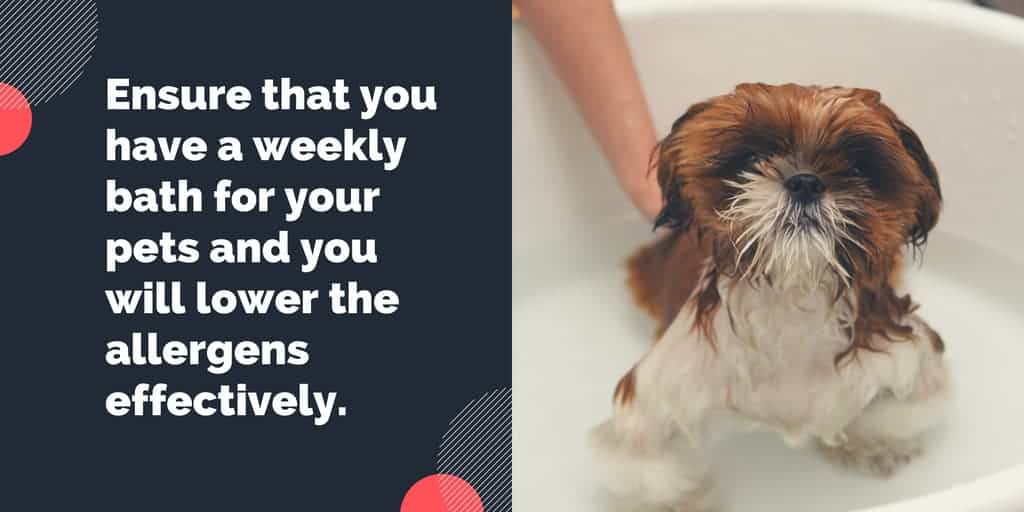
You also need to bathe them regularly to reduce the amount of hair that your pet sheds, and pet train them to stay away from some regions of the house, like your bedroom and your bed.
#02. Keep Up with Laundry
Pet hair builds up on your sheets, pillows, curtains, carpets, among other items and it can be challenging to deal with over a specific period.
Therefore, best of all is to…
Get into the routine of washing your sheets and pillowcases regularly.
For the cumbersome sets of furniture like sofas, you can result to using removable slip-covers that you can wash regularly.
#03. Consider Your Flooring Options
Carpets and rugs are the number one culprits when it comes to amassing pet hair.
Your dog’s or cat’s fur can quickly get stuck in the fibres of your carpets and rugs.
Moreover, your wall-to-wall carpeting design can create a difficult task for you, since the laundry will be too much.
So, it’s vital to get creative and invest in a cheap vacuum for pet hair – to keep the pet hair out.
And then….
Instead of relying on carpets, you can also opt to switch to hardwood2 or tile floors.
They are way easier to clean and even vacuum than the carpeted floors.
#04. Become Creative and Find Other Ways to Deal with the Pet Hair Menace
You can slave away a whole day trying to get rid of the pet hair menace from your home, but there will always be traces of their locks left on floors, towels, and other areas they frequently visit—even places you’d think they can’t reach. It can be an exhausting battle.
To stay ahead of the game, remember to keep a few lint rollers handy for a last-minute de-hair session on furniture and clothing. They’re lifesavers when you’re short on time or expecting guests.
You can also choose to dust the house regularly, but let’s face it—dusting alone often isn’t enough. Instead, consider combining routine cleaning with some highly effective pet ‘de-hairing’ techniques, such as using vacuums designed for pet hair.
For a comprehensive solution, an allergen-reducing air purifier can also be a big help in keeping allergens like pet dander and dust under control.
Curious if it’s the right investment for you? Learn how air purifiers help alleviate allergies and discover the transformative impact they can have on your indoor air quality.
For those looking to up their game, trying the best Dyson vacuums can offer powerful results, making cleaning up after your furry friends easier than ever. With the right tools, maintaining a fur-free home is not only possible—it’s simpler too.
#05. Clean Even Those Hard-to-Reach Areas
Do not forget to clean the attics and pent rooms since your pets can be spending most of their times there.
You can sweep up the areas or vacuum them at least once a week.
Simply put…
Removing pet hair from your haven will help minimize allergy discomfort3 and also make your home more put together.
Common Questions
[CUSTOM_FAQ]
In Conclusion
Pet hair can be such a drag, but if you follow these simple tips and tricks, you can keep your home pet hair free.
You can now be on top of cleaning any pet hair from your home! For more information, check out our online vacuum cleaner reviews.
Well, you need ‘t worry, you aren’t alone. According to recent studies, about three in ten people with sensitivities worldwide are allergic to cats and dogs.
However…
Sometimes I tend to jump to conclusions before getting to know the cause of the issue first.
But where to start?
You might realise that your pet isn’t to blame, but the pollen and dust they drag with them might be the trigger causing your allergies to flare up.
Allergens1 are everywhere in my environment. They’re present in the air, carpets, walls and even your water.
However, they all affect us in various ways. Some affect us when I inhale or ingest them, and others when they come into contact with my skin.
When they do so, then one can start showing some symptoms like a runny or congested nose, sneezing or itching. In extreme cases, they may cause shortness of breath.
So, how are pets a trigger to allergies?
Firstly, you need to know that animal dander isn’t the only thing that can trigger an allergic reaction. Dust mites,2 pollen, and mould are also common culprits.
With pets, however, the dander is the main culprit. Pet dander is the dead skin cells that your pet sheds, which when it comes in contact with an allergy-prone human, causes some allergic reactions.
Their droppings and saliva may also be the cause of the reactions, small cordless vacuum could be a good alternative.
How Do I Prevent Allergic Reactions from Occurring?
Well, there are some guidelines that one needs to follow to ensure that they keep their baby’s adverse pet allergic reactions at bay:
#01. Keep Your Kids Away from the Furry Companions
The only best way you can make sure that your baby doesn’t have an adverse allergic reaction is to ensure that you keep them away from the pets.
It might not be easy, but it’s necessary, especially when the vet recommends you take such an action.
You may also prefer to keep the pets away from the kids’ bedroom and other delicate rooms.
#02. Consider Some Deep Cleaning Measures
Dander and hair tend to collect on carpets and rugs. So, it’s essential that you increase the number of times you vacuum them and ensure that you invest in the best pet vacuum.
#03. Thoroughly Clean Pet Bedding
When you thoroughly wash any item in your house like pet bedding, slipcovers, throw pillows, curtains and other furnishings3 you will inevitably be reducing the number of allergens stuck in your home.
#04. Bathe Your Pet Regularly
Even though dogs may be more willing to endure the experience than cats.
Cleaning them not only reduces the number of pet allergens but it also helps in eliminating the allergens that collect in your pet’s fur, such as grasses and mold. Check The Best Dog Memes Ever
#05. Use Air Purifiers to Manage Allergies
Air purifiers are an excellent addition to your home if you’re battling pet allergies. They work by trapping airborne allergens like dander, pollen, and dust, significantly improving indoor air quality.
Wondering if they’re worth it? Discover how air purifiers help manage allergies to understand how they can make a difference.
Additionally, many purifiers are designed to specifically target allergens, helping to reduce pet-related symptoms and provide relief for your little ones by relieving allergic responses.
#06. Immunotherapy for Pet Allergies
When you suspect that your cat or dog might be the cause of your children’s pet allergies, then it’s time to consult the services of your allergist.
He/she might recommend some allergy shots since they help in reducing your child’s symptoms, learn about the best dyson for pet hair.
Simply put…
Allergy shots work by exposing your baby to a minute amount of an allergen, then slowly increase the amount over the course of months.
Eventually, the exposure to the allergen may no longer trigger a reaction, or it may only cause a mild reaction.
To help keep reactions at bay, a vacuum may just do the trick. Read our in-depth reviews to find out more.
Common Questions
[CUSTOM_FAQ]
In Conclusion
There are ways of handling children & pet allergies.
If you follow the tips that I mentioned, there shouldn’t be any allergy problem anymore.
Finding the right Vacuum Cleaner for you can be quite difficult, especially with all the choices available out there. A few common vacuum cleaner FAQs include:
Will it be the right one for me?
Would it remove my pet’s hair?
Is it really worth it buying this?
Are any of these questions buzzing around your head?
But where to start?
No need to worry anymore, I have all the answers you’ve been looking for right here.
It is an indispensable tool for cleaning floors, upholstery,1 and other surfaces in a house.
Here’s why:
These devices reduce potential allergens and improve indoor air quality.
There’s a vast assortment of choices, and some of the most popular styles include canister, upright, handheld, robotic, central systems and electric brooms.
They vary according to a variety of factors. They include the style and amount of carpeting within a home as well as the other surfaces that require cleaning.
Prospective buyers must consider their allergies and ability to operate the device.
Other issues are versatility and price. Some people purchase two or more options to clean their homes or vehicles.
You must also keep in mind that there are various models on the market.
Firstly:
There are the cordless or corded. Corded ones need to be connected to a power source to operate while cordless ones you charge before use.
The corded variety is more potent than the cord-free, but the cordless one is easier to move around the house.
Secondly:
Whether the machine comes with an attached dust bag or is bagless.
Most people might prefer to buy bagless ones because this cancels out having to throw out all the dust and dirt you have been vacuuming manually.
However, the machines that come with dirt bags are in most cases more efficient than those without the dirt-bags.
Thirdly:
You’ll find that it can be upright handheld or the stick variety. It’s the terms that define how you’ll use the machine.
The handheld type is comfortable to use almost anywhere because they have high manoeuvrability.
On the other hand, while the stick and handheld may be cumbersome, they are in most cases more powerful.
Last but not least…
There are the robotic, central systems and the canister.
The robotic need a remote control system, the central vacuum systems deposit dirt and dust in a receptacle located in a seldom-used area.
The canister options that have a long wand attached to a canister by a flexible hose.
They also include an engine and receptacle that collects dirt and dust.
So, whichever system you purchase, be sure to know the type that fits best with your lifestyle.
Q: How Often Should I Change the Bag?
A: It varies depending on the use, type of floors, pets, and the bag’s capacity.
With most of them, the bags need to be changed/replaced every couple of months, say two to three months depending on the amount of dirt collected.
With som like the Electrolux, Oreck, the bag change can be a little sooner, even weeks.
Vacuuming carpeted floors and homes with pet hair can fill a bag quickly, especially with your pets dragging their fur all over the house.
Fortunately for us, most of these systems come with a bag change indicator that makes your work easier by alerting you when a bag change is required.
Q: At What Point Should I Replace the Belt?
A: If you think yours is not cleaning as it used to or your brush roll has stopped turning, it might be a good time to change your belt.
First, you need to stop using it and unplug its cord. It isn’t hard to replace the belt if you own or have access to a screwdriver and a new strap.
For guidelines for your particular model, adhere to your proprietor’s manual.
Q: What are the Best Types of Bags?
A: Most companies and manufacturers advise their consumers to purchase branded replacement bags.
However, you can always find high quality and cheaper alternatives like the Airflo bags, Unifit bags, and Vivanco bags, among others.
An excellent bag should hold in the dirt for an extended period and are also impenetrable.
You mount it on wheels, thus enabling you to pull it around the room as you clean comfortably.
It’s easier to use than most upright options.
They are also highly versatile and capable of cleaning various surfaces because they have a variety of attachments.
Think about it:
In addition to vacuuming tile, wood floors, and carpeting, they can be used to clean draperies and upholstery.
The amount and type of cleaning that you must perform will help determine whether the machine requires additional attachments or not.
Q: How do They Work?
They have unique features that make them qualified to make your home better.
One of these crucial elements includes the advanced filtration system. Most have three filters: a bag, a chamber filter,2 and an exhaust filter.
The chamber filter is located inside the machine, behind the bag and in front of the motor.
The internal screen should always protect the engine and restrict air flow when clogged.
To add to that:
The exhaust filter, on the other hand, should be a HEPA Filter.
A sealed product has gaskets inside of it to avoid any leakage of debris and dust before it passes through the various layers of filtration.
Another essential feature should be the suction control system. It’s convenient to be able to reduce or increase suction by your floor situation.
Q: Do They Work Well on Pet Hair?
A: Pet hair is the most difficult to clean when they keep on dragging their hair to every corner of your house.
If you own a pet, you know how fur tracks its way into your carpet, corners, upholstery, stairs, and all the nooks and crannies around your house.
They provide you with the manoeuvrability to chase down pet hair wherever it lurks!
They have various features that make specific models perfect for trapping these hairs.
Q: Mine Just Stopped Working Properly. What do I do?
A: With these types of issues it’s always wise to consult your manual first.
The manual has a troubleshooting page, which gives you direction on how to check out your product. Remember always to unplug before examining it.
Look out for clogs in the hose, and look into its bag, which might be full. If the brush roll isn’t turning, check the belt and replace it if necessary.
You should also be sure to check out your electrical outlet and see if it’s working correctly. If everything else fails, take it to your nearest retailer for repair.
Q: How Many Filters does it Have?
A: Assume I are counting the bag, in case of a bagged vacuum system; most standard vacuums possess at least two filters. They are:
The Dust Cup Filter that traps dirt inside the dust container (for the bagless systems only)
For both bagless and bagged systems, there’s the Pre-filter that also referred to as the pre-motor filter, motor filter or after bag filter that filters your air before it enters the suction motor.
Another standard filter is the Exhaust filter, a.k.a the final filter, output filter or after cleaner that filters air returning to your room.
I have more in-depth guides. Please make sure to check out my guide on the Best top canister vacuum.
Q: How Should You Optimize a Cordless Vacuums Battery Life?
A: They can be of great help when it comes to cleaning up spills where you don’t have a local electricity supply.
Therefore, optimising the battery life of these cleaners is a good idea but not as simple as it might sound.
If yours runs on standard batteries, the only justified way to ensure they last longer is to make sure that there’s no ‘standby’ function on your battery-powered option.
All you need to have is an on/off switch. When it comes to options that run on rechargeable batteries, they come in a design that expects you to store the battery charger.
It ensures that the cells are full at all times. Lastly, always keep it stored in a cool rather than an ice-cold location.
Q: How Long do These Vacuum Cleaners Run On Battery Charge?
A: It depends on a few things. One is the size of your house and secondly, the type of battery you use.
Lithium batteries are better and they store enough charge to last you for a day.
Secondly, considering the length of your room and the number of floors you need to clean.
They serve most people’s needs for a quick solution for daily use. No cords, no fuss.
Q: What Type of Vacuum Cleaner is Efficient for the Stairs?
The best vacuum cleaners for household cleaning depend on a variety of factors.
These features include the style and amount of carpeting within a home as well as the other surfaces that require cleaning.
One requires a product that has strong suction power, which is essential especially where small particles can become ingrained into the cracks, among other features.
Q: How do They Work?
Unlike most regular vacuum cleaners, hoovers factor in unique features.
They are specially designed to cater for these types of tiers, and thus you need to consider some elements carefully.
Important to note:
For one, you should avoid beater brushes.
These thick brush rolls are designed to dig into carpet fibres, and this can cause severe damage.
Another important feature is the suction power. Having strong suction is not only useful for carpeting, but also for hard surfaces where small particles can become ingrained into the cracks.
What does it mean to you?
Getting one that works also involves considering the weight and compactness of the sweeper.
It makes it a lot easier to manoeuvre and reduces the risk of causing accidental scratches and scuff marks.
Last but not least:
Another semi-crucial element is the rubber or felt stripe padding. It’s a great way to ensure that the machine won’t cause any accidental scratching.
Q: What Should You Consider?
A: First and foremost, avoid rolling brushes. Rolling brushes are designed to lift dirt, hair, and debris that hide inside carpets.
For hardwoods, this is not an issue. The rolling brush will do more harm than good as it will leave scratches the wood.
If you cannot find one with no rolling brush, then choose one that can allow you to switch off the brush attachment, thus preventing it from spinning.
Secondly, look out for vacuum systems with padding and rubber wheels. They help prevent scratches and other damages.
Thirdly, consider the compactness and lightness of the vac.
Lightweight vac models are easy to carry around and effortlessly glide across the floor for effortless cleaning. The less pressure you apply, the better.
And lastly:
Check out that it has good suction power.
Superior suction quality and control are a must since the two ensure that no dust, dirt or debris is left behind.
Q: What Company Makes the Best Hardwood Floors Vacuums?
A: Over the years, Dyson Vac Company has introduced some great vacuum cleaners that can clean up efficiently and leave no marks.
The Dyson V8 Animal Cord-Free Vacuum Cleaner is one of the top options on the market. First of all, it’s cord-free, making it very convenient.
It features the V8 motor which offers you the most powerful suction and the HEPA filtration system that captures allergens and expels fresh and clean air.
It also converts into a handheld vacuum system for quick clean UPS, spot cleaning, and cleaning difficult places. It makes up for the best cleaning system.
Q: What Do Vacuum Cleaner Companies Refer to as a Sealed HEPA System?
A: The sealed HEPA system is not only a HEPA filter but also an entire system that meets HEPA standards.
The systems accomplish this by preventing air that is passing through the system from escaping around or under the air filter.
If you possess a HEPA filter but the air escapes without passing through it, the screen won’t complete its intended purpose.
The system avoids this by using special filter mountings and other techniques.
Q: Are Robotic Vacuum Cleaners as Effective as the Every Other Day Cleaning Robot, Which Doesn’t Intend to Replace a More Powerful Vacuum Cleaner But Just for Light Cleaning?
A: They have come a long way.
You don’t have to suffer the indignity of dragging around an unwieldy, cumbersome product connected to a clumsy, wheeled canister the size of an elephant anymore.
In fact
You don’t even need to get off of the couch or your silky office seat.
Although it still feels like a relatively new product, there are numerous excellent robotic vacuums available to assist you in disposing of dust, pet hair, and other debris in your home—without needing to lift a finger.
Q: Why are Robotic Vacuum Cleaners Round?
A: A robotic vacuum cleaner is a type of vacuum system that is programmed to clean without requiring any human intervention.
The RoboVacs utilise additional features such as spinning brushes, UV sterilization, and mopping.
Want to know more?
It’s round because the roundness improves autonomy.
When a circular robot (with drive wheels coaxial with the robot diameter) manoeuvres into a corner or narrow space, it can always turn in place until it manoeuvres its way out.
The strategy requires no sensor other than a bumper.
With a non-round robot, however, it must execute a more complicated series of wanders to extricate itself.
Also, the correct moves can’t be computed unless the robotic system knows the shape of the local space.
Thus a non-round robot is more likely to get stuck. With that, the round robot vacuums are the best robotic vacuum systems.
Q: How Many Sensors are There in a Robotic Vacuum Cleaner?
A: The number of sensors a vacuum cleaner has depends on the robotic cleaner itself.
However, there are some tasks that all of them share and the corresponding sensors that can perform these tasks:
#1. Detecting Obstacles
There are mechanical bumpers that are mostly in front of the robot when it touches a wall or an obstacle.
There are also proximity sensors that are either infrared or ultrasound.
#2. Not Falling Off A Staircase
For this specific task, the robotic cleaner has surface sensors under the robot that detect the absence of surface.
Imagine this scenario: you bought a new house. You’re excited and can’t wait to make fresh memories with your kids.
As outstanding as your new home is, there’s a lot of dust, and the pets keep dragging hair and dirt onto your carpet.
But where to start?
With all this and with your allergies flaring up, you’re looking for a viable solution.
To add to that…
You’ve probably tried some cleaning products, but none seems to get rid of the problem entirely.
So, with a few consultations, you’ve realized you need a more permanent fix – to get a vacuum. Now the question is: Bagless vs bagged vacuums. Which is best?
However…
With all the options available, you’re confused about what type of household vacuum cleaner to purchase.
Should you pick the heavily advertised cordless hoover, or should you check out the bagged and bagless models?
Well, lucky for you…
With the right guidance, you can have an effortless time shopping for a perfect vacuum that’ll make all your dirt and pet dander issues a thing of the past.
But first…
Let’s delve into the ultimate vacuum cleaner comparison of bagged and bagless options and see if either can be the answer you’ve been looking for.
Bagged Vacuum Cleaners
Bagged vacuums work in the more conventional way of using a replaceable bag as a filter to capture dust and debris while also enabling air to flow through the bag. You also have to replace them frequently.
Let me tell you more…
Replacing the dirt container isn’t necessarily a difficult task, and most dustbags2 aren’t costly.
However, it might be inconvenient to have to remember to keep checking if the container is full.
There are several bagged vacuum designs, and some of the best ones feature an indicator light that alerts you when the bag needs a replacement, thus making your work easier.
But that’s not it…
One of the most impressive features of bagged vacuum cleaners is that you don’t get into a lot of contact with the dirt, allergens, and debris.
All you have to do is slip out the old dirt container, throw it away, and replace it with a fresh one.
So, if you’re looking for convenience, the bagged option might be your best bet.
The Pros of Bagged Vacs
Unlike the bagless, the bagged option is less messy. There’s little to no chance of the dust particles winding backing up on the floor or your face.
They’re perfect for those suffering from allergies. Bags keep dust and allergens entirely separate from the person doing the vacuuming. As a result, disposing of dirt is much less likely to trigger an allergic reaction.
And that’s not the end of the story…
They require less maintenance. Bagged vacuums give you a relaxing time by taking off the stress from your sweepers. Since the filters are built into the bags themselves, you need not clean the filters. The containers also hold more dirt than their bagless counterparts, so you don’t have to dump the trash as regularly.
The Cons of Bagged Vacs
The hoovers aren’t eco-friendly. While most dustbags are mostly made of paper, they also have other materials that might be nonrecyclable. So when you throw away the container, you also toss away the trash, and they’ll likely wind up in a landfill.
It’s true…
They’re costly. While these systems aren’t likely to break your bank, they cost money that you, quite literally, throw away when they fill up.
Bagless Vacuum Cleaners
Bagless vacuum sweepers use filters to capture the dirt and debris in your home in a dirt cup or chamber that you can then empty.
Think about it:
Unlike the bagged version, with the bagless hoovers, you don’t have to worry about forgetting to empty the hoover.
Since you have a clear view of the dirt and other particulates in the cup.
Once the dirt and debris meet the fill line, then you have to empty the container and put it back in.
That sounds straightforward, right?
Indeed, they’re effortless to use.
However, several models feature filters that you need to brush, wash, dry, or completely replace. So you must ensure that you’re precise about the bagless vacuum model you need for your family.
Moreover…
Emptying the dirt cup can be messy, depending on the vacuum cleaner.
Dust often billows back out of the container, or you may be needed to shake or pull out the compacted dirt from the bottom of the dust cup.
Nevertheless, if you accidentally vacuumed up an object that you need to get back, then all you need to do is to remove it from the dirt cup.
The Pros of the Bagless Vacs
Bagless vacuums are environmentally-friendly. Unlike their counterparts, these feature reusable filters,3 and, of course, don’t feature dust containers that wind up in the nonrecyclable trash bin.
Just give it a thought!
They help you save up on cash. Once you purchase the bagless option, your spending is complete—you need not keep investing in bags to keep your house clean.
The Cons of Bagless Vacs
They’re messy. When you take out the cup and start dumping the dirt, you have to stick your fingers in the dust and dirt, thus making you cope with the resulting dusty residue. However, by getting gloves, you can avoid the mess and enjoy the services that your bagless vacuum offers you.
It’s true…
They’re more time-consuming. While the bagged options require you to pull out one bag and pop in another, with the bagless, you need to ensure you carefully clean and wash the dirt cup. So, you have to empty the dirt cup, brush it, wash it with detergent, dry it, and then put it back into the vacuum cleaner.
Turns out…
They’re more likely to trigger an allergic reaction. Depending on how you handle it, there might be a dusty blowback when it comes to a bagless vacuum filter that can easily set off an allergic response.
Common Questions
[CUSTOM_FAQ]
In Conclusion
There’s no denying that both the bagged and bagless vacuum cleaners have their own set of perks and drawbacks, evident when pitting them against one another in a battle of bagless vs bagged vacuum cleaners,
However, they’re both effective when it comes to helping you keep your home spotless and fresh at all times.
Neither of them can ultimately be crowned the best option because it all comes down to knowing what you require, depending on your home needs and reviewing what you want in a vacuum cleaner.
With the many models, brands, features, and accessories on the market, choosing a perfect vacuum can be very confusing.
You need to research and find out what you need the hoover for and which features will work best with your situation.
After that:
When you know what you need from the sweeper, then you can head on out to buy one.
However, if you’re not sure about what you need, you can always consult your local vacuum cleaner store or read through some guidelines and get the hoover that works best for you.
Here’s a comprehensive guide about vacuum power and how amps affect the device’s capability to get rid of the allergens in your haven.
Defining the Amps of a Vacuum Cleaner
The first thing you have to comprehend is how amps are measured, and also realise the difference between amps and watts.
Basically…
Amps and watts are the two most common things you hear when it comes to a vacuum’s power consumption. There’s a significant difference between the two.
Amps are the units of the current flowing, while watts are the units of power that can be measured. Amps apply to electricity, and wattage can be used for other forms of energy.
Do you get the picture now?
Okay, read on.
How Many Amps Does Your Vacuum System Use?
Most of the upright and canister vacuum cleaners have about 8- to 12-amps.
The household outlet you plug your sweeper into holds a maximum of 15 to 20 amps depending on the circuit.
However, even with the variation in amps, 12 amps are the maximum allowed for UL approval, so you can’t get a vacuum with more than 12 amps.
Why Amps Aren’t a Dependable Gauge of Suction Power
Amps measure the flow of the electrical current going from your outlet to the motor of your vacuum.
While most models feature “12 amps” as displayed by their manufacturers, it doesn’t necessarily mean that having a 12-amp1 hoover doesn’t guarantee you that you own the most powerful cleaner on the market.
It’s all dependent on the manufacturer’s design of the motor that uses the amps effectively.
That said…
Here are several factors other than amperage that significantly influence the cleaning power of a vacuum cleaner:
The manufacturer’s design. Contrary to most people’s beliefs, the manufacturer’s design has a massive impact on the vacuum performance. Some of the versions come with two or even three fans2 that work together in harmony. (Vacuum cleaners with a two-motor fan typically produce better output, primarily when you use on board attachments. Idyllically, most canister vacuums are two-motor optimised, while the upright versions mostly have a one-motor system).
The filters’ condition and the way the system traps and filters the dirt also affects the vacuum’s cleaning power. To get the most out of washable filters,3 you need to ensure that you regularly clean them based on the manufacturer’s recommendations for optimum airflow.
The floor nozzle design and hose also have a significant impact on the hoover’s performance.
Another feature is the height adjustment settings on the carpet or surface.
If you own lightweight bagless vacuum cleaners, you need to make sure that you keep emptying the canister or bag when it’s full to boost the suction power. Suction is drastically reduced when the bag, dust cup or canister is full.
The airflow specification also has a massive impact on the cleaning ability of the vacuum system. It’s measured in cubic feet per minute (CFM), and the more airflow the vacuum has, the better its cleaning ability.
Simply put:
Buying the best budget robot vacuum isn’t rocket science. You only have to look into some factors carefully before you head out to shop for one.
Common Questions
[CUSTOM_FAQ]
In Conclusion
If you want a sweeper with high power, be sure to read the above guidelines and check the vacuum cleaner amps, and you’ll get the vacuum that’ll help you eliminate dust and allergy problems efficiently.
It can easily happen that you mistreat your vacuum cleaner, especially after getting home after a tedious day at work to find your kids playing around the mess they’ve made on the floors.
Well, if you have someone to help you out or own a quality vacuum cleaner, then taking care of that mess will be easy.
However…
If you’ve been mistreating your hoover and somehow damaged it, you can’t get rid of that disarray the easy way.
It’ll probably take you two hours to clean up manually, and you’ll eventually end up feeling worse than when you came home.
But where to start?
Let me tell you this:
Vacs typically stick with their users through thick and thin.
The way you try so hard to make your nanny happy or treat your phone like your most valuable asset is the same way you need to take care of the hoover.
So that it can swoop in and suck up the worst messes right when you need it to.
That said…
Whether you own a robotic, cordless, canister, or a bagless vacuum, there are several things you shouldn’t do to your sweeper. Here are some but a few:
#01. Vacuum Over Hard Objects
When you’re too tired to bend over and pick up things.
You might get tempted to run your vacuum over the pennies and small rocks on your floor rather than stooping over to pick them up.
In any case, it seems so harmless, right?
Well, you see…
You’re wrong. It’s one of the gravest mistakes you’ll ever make.
These hard objects can cause severe damage to your device and its interior, or they can become lodged inside areas that’ll be challenging to remove them from.
Of course…
It might be true that it won’t ruin your vacuum every time, but that one time will be more than enough to force you to buy miele vacuum.
Therefore, to be on the safe side, even when you’re too tired, avoid the risk and pick up those objects manually.
It’ll save you hundreds of dollars!
#02. Vacuum Over Water
Another vacuuming ‘mustn’t do’ is running it over water.
While it might seem harmless, standard vacuum cleaners aren’t designed to pick up water.
Here’s why:
If you get tempted to run the device over a pile of water, then you run the risk of getting electrocuted or cause severe damage to your machine.
Even if you don’t end up electrocuted, or possibly ruin the hoover, you’ll have a revolting mess on your hands when you empty the dirt bag or bin later on.
To tell you more….
There are wet or dry vacuums that are uniquely designed to handle picking up water without risking your life or damaging the sweeper.
They’re also relatively cheap and can be an excellent addition when you need to vacuum water or liquid up.
However, when it comes to regular hoovers, make sure that you avoid water at all costs.
#03. Let the Vacuum Cleaner Run Overfilled
If you own a bagged vacuum, then you know that when the dirt fills up, you need to throw away the bag.
If you, for whatever reason, opt not to empty the dustbin,1 then the performance of the vacuum will be drastically worse.
To add to that:
You also run the danger of overheating and destroying your sweeper.
If you notice that the vacuum device doesn’t offer adequate suction power, then you’ll need to check the bin or bag first before you check other features.
Most of the time, throwing the dirt and dust away can make a significant difference in how excellent your hoover will be at cleaning your floors.
#04. Vacuum Over Those Pesky Electric Cords
Vacuum cleaner cords are very robust and able to endure some trauma.
However, when you run over a hoover with a spinning brush2 over an electrical cable, then you risk damaging it. The same motion that forces the dust and debris up into your device can fray or ruin the exterior of the cable.
With time, even the most secure cords will start to show damage, thus making them unsafe to use around your home.
#05. Throw it out because it Lacks Enough Suction
Perhaps your vacuum cleaner doesn’t work as quickly, or it isn’t picking up the dirt the way it used to.
If you end up assuming that it’s old and you need to replace it, there’s a chance that you might be thinking wrong.
First of all…
You need to check the dirt bag, or on a bagless vacuum, the dust cup. There are times that a full or nearly full vacuum will function very poorly.
If emptying the dirt bins or dust cups doesn’t help, then you need to check if there’s any blockage in your hoover.
Here’s how you do that:
You have to unplug your appliance and conduct some detective work. Firstly, you have to check the hose.
Is it blocked?
What about the openings where the tube goes into your vacuum cleaner?
Is the brush roll turning as freely, or are there some hairs and strings from your carpet built up and require to be removed?
You also have to remember that you have to take care of your hoover at all times, and it’ll be running like it’s brand new.
#06. Assume that the Motor’s Damaged
Sometimes the vacuum cleaner can suddenly overheat and turn itself off.
When this occurs, most people assume that it’s the end of their high-quality vacuum.
However…
There are some ways to get your machine back in working order.
You should try checking if the dirt bag is full or if there’s hair or fibres wrapped around the machine’s brush roll, thus causing it to overheat.
If that’s so, you need to fix these problems and check for any clogs then turn the vacuum back on.
You’ll be surprised that most times, that will be all you need to fix the issue and get your machine back to business.
Nevertheless…
You need to know that some vacuums feature a manual reset button. In such cases, you need to refer to your manufacturer for guidelines to reset your machine.
Moreover, maintaining the hoover daily will prevent this issue from happening.
Common Questions
[CUSTOM_FAQ]
In Conclusion
Your vacuum cleaner might be the most versatile machine in your cleaning arsenal, but that doesn’t mean that it should suck up all your messes.
It might be tempting to give some household dilemmas a quick back and forth, but you’ll end up regretting later.
Avoid taking unnecessary risks and mistreating your vacuum cleaner, and your machine will reward you with excellent service.
If you’re looking to find out more, take a look at our vacuum reviews!
Whether you’re rethinking your space or looking for a sense of levity, the landscape of your house has never mattered more.
It’s the reason most people are opting to invest in carpeting rather than having bare tiled floors.
It doesn’t matter if you get the Victorian style carpets or a simple soft carpet, rugs give your home an aesthetic feel.
Moreover, thanks to technology, keeping these carpets free from pet dander, dust, and other dirt particulates can be effortless, with the right vacuum cleaner. Buthow often should you vacuum carpets?
However, look at this…
In as much as vacuums keep your rugs tidy, some people who vacuum their rugs daily say that certain vacuums damage carpet fibres.
It’s mostly because of the rotating beater bar in the device that pulls, stretches, and wears out your carpet fibres.
According to experts, though, while this might be true, dirt has more of a wear-and-tear-impact on your carpets and rugs than most vacuums do.
You might be wondering…
Be that as it may, one question lingers, how often should you vacuum your carpets to avoid any damaging effects?
How You Can Vacuum Effectively
If you have the best vacuum for carpets, with multiple settings that let you customise surfaces, you shouldn’t vacuum your carpet on the bare floor setting.
Instead, you can use that for the bare floors and use the carpet setting for your rugs, as the vacuum’s instructions indicate.
Let me tell you more…
You might also want to see if the sweeper has a height settings feature.
These settings can have a significant impact on how the hoover works or wears your carpet.
If you set it too low, for instance, you may damage the rug or the vacuum’s roller brush1 and the drive belt.2
On the other hand, if you set your hoover too high, it won’t pick up any dust particles as efficiently.
However…
If you’re not sure how high or low you’re vacuuming, make sure you turn it on at the top-most setting and then lower it until you can feel the sweeper tugging at the rug.
How You Can Clean Your Carpet Efficiently
When it comes to vacuuming your carpets, there are some fundamental rules that you need to follow to the tee.
One of the most common rules is to avoid, at all costs, vacuuming over hard or massive objects.
While it can be tempting, rocks, coins, and other materials can have irreversible damages to your vacuum cleaner, or they might get stuck in it.
To add to that…
It would be best if you also avoided running your device over water, letting it run with the dustbin3 over capacity or over that pesky electric cord.
Vacuums are expensive, and you need to treat them with care.
Therefore…
When cleaning your carpet, ensure that you use a mix of these general guiding principles and the manufacturer’s instructions as well.
How You Can Protect Your Carpet
To safeguard your carpet and rugs adequately, you need to vacuum entrance areas and the high traffic spots at least twice every week, and the rest of the carpeting weekly.
Oily soils build upon themselves, and regular vacuuming ultimately gets rid of the soil build-up.
Want to know more?
If you’re apprehensive about your carpet getting destroyed, you might want to consider buying a rug protecting spray.
It’s efficient, and you can easily apply it on your carpet.
However, you first need to check if your carpet is under any warranty.
If it’s under one, you must avoid adding any cleaning products onto it as it can void the warranty entirely.
But wait, here’s more:
Another critical factor is to consider the material of the carpet.
If you own a thick shaggy rug, you have to ensure that you’re more careful and that you clean it more frequently than your thinner and shorter carpets.
It’s because shaggy and thick carpets can hide dirt better than their shorter and thinner counterparts.
Nevertheless, they’re more difficult and time-consuming to clean, so you need to allocate some time for proper deep cleaning.
Common Questions
[CUSTOM_FAQ]
In Conclusion
Carpets are beautiful, and in as much as they make your home cozier and avant-garde, they’re very costly.
Therefore, you need to be careful when cleaning them, more if you use an ash vacuum cleaner.
Make sure you follow the above guidelines on how often you should vacuum carpets, and you’ll maintain your carpet for longer.
This article will discuss this question and give you some tips on knowing when it’s time to change your filter.
Why Should You Replace Air Purifier Filters Regularly?
Many air purifiers are designed to maximize their effectiveness by removing as many particles from the air as possible.
This includes allergens1, bacteria, and other harmful substances that can cause illness when entering someone’s lungs or eyes.
When an air filter becomes clogged with these impurities, it will no longer remove them effectively, which means you won’t get as much protection against pollutants in your home environment.
How Often Should You Change Your Air Purifier Filter?
The frequency of when a person should change their filter depends on three factors:
What type of filter is being used, how often the unit is running, and whether or not there have been any major changes in the household (i.e., pets, smoking, etc.).
For example, suppose you’re using a washable filter and have the unit running every day in a household with pets that recently installed new carpeting.
In that case, it’s likely your air purifier will need to be changed more often than someone who has an ionizer2 model.
How Can I Know When My Filter Needs Replacing?
Some people may not realize their filter needs to be changed until they notice a decrease in the air purifier’s effectiveness.
If you notice that your unit is no longer removing particles effectively, it might mean it’s time to change or need more frequent use of the machine.
Other signs that your air purifier filter needs replacing:
Reduced performance from normal; especially since an increase in dust and other allergens has been present recently
You can smell odors coming out of the vents, even when running at higher speeds
These signs could indicate that there have been changes in your home environment or what type of filtration system you’re using. It would then likely be time to replace the air purifier’s filter.
Do All Filters Need to Be Replaced?
Some air purifiers will have a permanent or washable filter that never needs to be changed.
These filters typically require cleaning, which can be done using hot water and detergent every month.
It’s important to know what type of filtration system you’re using before purchasing an air purifier because they are not all created equal.
It’s also recommended that people follow the owner’s manual for their specific machine to determine when it might need more frequent use or replacement.
So What Frequency Is Best?
It depends on several factors; here are some general rules for determining when it’s time to change your filter:
Default Indoor Air Quality
The air in your home will be cleaner if you have a HEPA filter3 running for at least 12 hours each day.
The more time the unit runs and the less dust or allergens hanging around to clog up an air purifier’s filters, the quicker it’ll need to be changed.
However, this doesn’t mean those with adjustable speed settings should run them constantly because it can put unnecessary strain on your machine.
Live in an area where there has been construction or remodeling going on recently.
Changing your filter sooner might also be necessary as these changes cause increased levels of particulates floating about, which could get caught inside a clogged-up filter.
Frequency of Usage
The more often your air purifier is being used, the more quickly it will need to be changed.
If you’re running an ionizer model all day long, then a filter change might not be necessary until after six months of use.
If you’re using a washable or permanent filter and have been running your machine daily for about 12 hours with no changes in a household environment, likely, they won’t need changing for at least three-six months.
Water Quality
The quality of your water can also have an impact on how often you’ll need to change a filter.
If you live in a city with high levels of air pollution or are using well water, it might be necessary for filters to be changed more frequently than someone who lives near the ocean and has clean drinking water coming out of their tap.
Filter Type
The type of filter also has an impact on when a replacement might be necessary.
If you’re using a HEPA, or High-Efficiency Particulate Air filter, then it’s likely that this will need to be replaced every 12 months as the lifespan is limited due to the finer particles these filters catch and what they are used for indoors.
If you have pets in your home and recently got new carpeting installed, then it’s likely that your air purifier will need to be changed more often than someone who has an ionizer model.
It depends on many factors about how frequently one needs their filter replaced, but most manufacturers recommend changing them around once per year, if not sooner with heavier usage.
General Filter Replacement Schedule
The following is a general timeline for how often filters should be changed:
Permanent filters will only need to be cleaned once a month with hot water and detergent.
HEPA or High-Efficiency Particulate Air Filter should be replaced every twelve months if they run for the majority of each day. Otherwise, six months is enough since these types of filters work harder than others.
Washable/reusable filters should also be changed after 12 months but can last up to 24 depending on frequency use and if there have been changes in a household environment.
Ionizer models might not require changing until around six months depending on how often it’s being used and which type of filtration system it’s used, as well as any other factors specific to the user such as pets or new carpeting installed.
Air purifiers with activated carbon filters4 should be changed every six months.
Air purifiers with electrostatic filters should be changed every 12 months.
Tips for Making Sure Your Filter Lasts as Long as Possible
Replace filters in the spring to avoid allergy season5.
Change filters when you change your air conditioner filter or furnace filter, which should be done at least twice a year for best results and maximum cleanliness.
Keep pets out of rooms where there is an air purifier running as they will track more pet dander into the room on their paws, and it can cause clogs over time if not cleaned up promptly after being brought inside.
Tips for Avoiding Clog Build Up When Replacing Your Filter
It’s important to take care of your machine by changing its filter regularly.
Still, some tips that might help reduce the chances of build-ups are keeping animals off furniture where the unit is located, cleaning any debris from around machines, and ensuring adequate airflow throughout the room.
Common Questions
[CUSTOM_FAQ]
In Conclusion
Changing the filter in your air purifier is important for maintaining high air quality, but how often should you replace it?
The answer to this question depends on several factors, including the size and type of your home.
Someone living in a small apartment with two or three cats may need to change their filters more frequently than someone who has five dogs living in a large house.
But no matter what kind of person you are, these general guidelines will help you know when it’s time to change your old air purifier filter for a new one.
You can often find relief from common household allergens like pollen, dust mites, and pet dander with an air purifier.
Over half (53%) of households with asthma have a HEPA filter in their home.
Allergies are one of the leading causes of children’s trips to the emergency room, so parents need to take these symptoms seriously.
In addition to allergies and asthma, there has been some research into how helpful they can be against coughs.
A study out of Korea found that using an active carbon filter1 effectively reduced respiratory illnesses such as colds, cough, or pneumonia by 16% among children.
Another study found that children with asthma who slept in a bedroom with an active carbon filter had fewer coughing attacks and better sleep quality than those without the extra layer of filtration.
These studies show promising results, but more research is needed to understand how these filters work against coughs fully.
We’ll keep you updated as I learn more.
Can an Air Purifier Make a Cough Worse?
While there is some evidence that many air purification devices can help reduce the severity of coughing, it’s important to remember they are not a cure-all.
If you already have a chronic cough2 or asthma, an air purifier may worsen your condition because these filters work by removing particles from the air.
They also remove beneficial compounds like humidity and allergens, which could trigger bronchial spasms (sudden contractions of muscles around breathing passages).
If someone with asthma were relying on those triggers for relief instead of their usual inhaler treatments, the filter would essentially interfere with their treatment plan.
Discover insights from industry leaders on how effective air quality management enhances health.
How Can an Air Purifier Help Relief Cough?
An air purifier can help you relieve a cough in many ways.
First of all, an air purifier is your best friend when it comes to removing the allergens that are most commonly linked to coughing and other respiratory issues3 such as asthma or hay fever.
Second, a good-quality air purifier will filter out various pollutants, including dust mites that may trigger your allergies and make them worse.
If you suffer from bronchitis or pneumonia, these machines have been proven to make patients recover faster by improving their oxygen intake and eliminating toxins from the air responsible for lung infections.
Coughing can be very annoying, especially when you have to deal with it daily. If this is your situation, I suggest getting yourself an air purifier as fast as possible because it will help eliminate all those respiratory issues once and for all.
When Should I Use an Air Purifier?
Using your air purifier is highly recommended at all times, but especially so during cold and flu season as well as periods of high pollen exposure.
If you have a child with allergies or asthma, it’s important to keep an extra one around their room if possible because they are more likely to benefit from that protection.
If someone in your home has bronchitis or pneumonia, then make sure everyone keeps theirs on for longer than usual since this will reduce symptoms faster and help prevent them from coming back.
If someone in your home has a weakened immune system because of old age or chronic illness, it’s best to keep the purifier running 24/7 since that will help them get better faster and have more energy throughout the day.
Finally, if you are suffering from allergies or asthma, an air purifier is one of your most powerful allies, so don’t hesitate to use it as often as possible.
Take a look at this article to explore the broader impact of air purifiers, including on nasal congestion.
Can I Use an Air Purifier When I Have Severe Cough?
You most definitely can use an air purifier for relief when you have a bad cough.
However, if your coughing has become so intense that it’s causing chest pain or shortness of breath, then this might be the time to see a doctor instead of trying to deal with it yourself.
When in doubt, always consult with a medical professional before using any new treatment method since they will be able to tell you whether or not it’s safe for you and what other steps should come first.
While there are no side effects associated with running an air purifier at home, it’s best not to try anything out on your own without guidance from someone who knows exactly how your body works, as well as where all those mysterious aches and pains come from.
What Type of Air Purifier Is Good For Relief Cough?
While all air purifiers are good for relieving a cough, some are better than others.
If you have pets at home, then your best bet is to get a purifier that has an activated carbon filter because it will work most effectively on pet dander and other allergens, which could be triggering your issues and making them worse.
If you don’t have any animals but still suffer from allergies or asthma, then opt for one with a HEPA filter4 instead since they trap dust particles more efficiently.
This means fewer coughing spells throughout the day simply by running this type of device in the background while you sleep every night.
Finally, if someone in your house suffers from bronchitis or pneumonia, then I suggest getting yourself a medical-grade air purifier that uses ozone to kill off germs and bacteria.
Common Questions
[CUSTOM_FAQ]
In Conclusion
Your air purifier may provide some relief for those who suffer from chronic coughs.
If you have trouble breathing because of a persistent, dry cough or if your spouse is struggling to sleep at night because of this same issue, it’s worth considering an air purifier in the bedroom.
To use your air purifier for coughs, place your air purifier up high on the wall and keep all windows closed while running for the best results.